
How to Identify Termite Mud Tubes — and What to Do Next
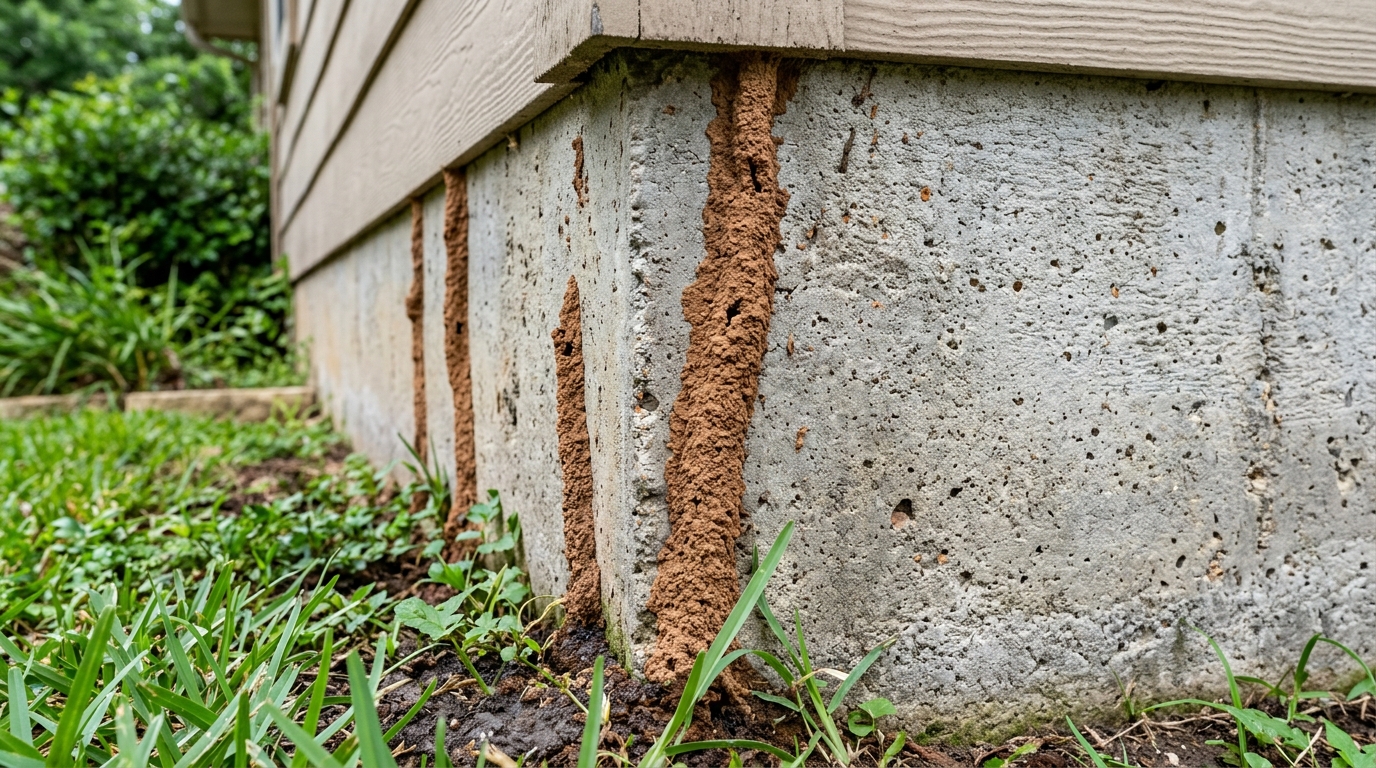
Of all the signs that subterranean termites have found your home, mud tubes are the most definitive. They are not ambiguous — if you see a tube made of soil and debris running up your foundation wall, crawl space piers, or plumbing pipe, termites built it. The question from that point is not what it is, but how active it is and what to do next.
What Are Mud Tubes?
Mud tubes — also called termite tubes, shelter tubes, or foraging tubes — are tunnels built by subterranean termites from a combination of soil particles, wood particles, and saliva. They serve one essential function: they protect the termites from the open air. Subterranean termites are extremely vulnerable to desiccation and light exposure. Without a humid, dark tunnel connecting their underground colony to above-ground wood, they would die before reaching your framing.
The tubes are typically about the diameter of a pencil — sometimes wider if the colony is large or the tube is well-established. They may run vertically up a foundation wall, diagonally across a concrete pier, or horizontally along a sill plate or rim joist. In some cases they bridge across gaps — for example, across the space between a concrete block and a floor joist — in which case they are called "drop tubes" or "hanging tubes" and are free-hanging rather than attached to a wall surface.
Where to Look for Mud Tubes
Common locations in Walker County homes:
- Foundation wall exterior: The outside face of the foundation, particularly near weep holes, utility penetrations, and expansion joints
- Crawl space piers and sill plates: Under pier-and-beam homes, termites build tubes from the soil directly up concrete piers or wood posts to reach floor joists
- Garage slab edges: Interior garage perimeter, particularly where the slab meets the wall framing
- Plumbing pipe penetrations: Termites follow pipes through slabs — tubes often appear where pipes emerge from the floor or wall
- Exterior door frames and window sills: Where wood meets concrete or masonry at grade level
Active vs. Inactive Mud Tubes
Not every mud tube contains active termites. Colonies move, and previously active tubes can be abandoned. Knowing whether a tube is active changes your response:
- Break a small section of the tube. Repair activity — new soil and saliva filling in the break — within 24 to 48 hours indicates an active colony. No repair usually means the tube is inactive.
- Look for live termites. If you break the tube and see white-bodied workers moving inside, the colony is active in that area.
- Note the texture. Active tubes tend to be moist and slightly flexible. Inactive tubes may be dry, brittle, and crumbly.
An inactive tube still has meaning — it confirms the structure has had subterranean termite activity in the past, and that a colony was at some point present and active enough to have built foraging infrastructure. The absence of live termites in the tube does not mean the area should be ignored.
Mud Tubes vs. Ant Tubes
Carpenter ants do not build mud tubes. If you see a tube-like structure, it is termites. However, ants do sometimes use abandoned termite tubes. The distinction matters because carpenter ants are treated differently from termites. If you are uncertain what you are seeing, collect a sample of the tube material and any insects you find, and call for an inspection.
What To Do When You Find a Mud Tube
Do not spray it with consumer insecticide. Repellent insecticides applied to a mud tube will cause termites to abandon that tube and build another nearby — you lose visibility into their activity without solving the problem.
Do not knock it down and ignore it. The tube is evidence of a colony, not the colony itself. Removing the tube while leaving the infestation untreated accomplishes nothing.
The appropriate step is to call a licensed termite control company for an inspection. The inspection will confirm species, locate additional activity, assess the extent of any damage, and provide treatment options. A mud tube visible from outside is often the tip of significant activity that is not visible at all.
In Huntsville and Walker County, call Huntsville Termite Solutions at 936-935-0197 to schedule. We offer same-day and next-day inspections throughout the area.
One More Thing
Mud tubes appear because a colony is foraging — which means they have not necessarily reached the wood inside your walls yet. Finding a tube on the exterior foundation early is actually a best-case scenario: the colony has declared its presence before it has caused significant structural damage. Early detection and treatment is always less expensive and less disruptive than treatment after damage is done.
If you found mud tubes on your property, schedule a termite inspection — we provide subterranean termite treatment throughout Huntsville, Madisonville, and surrounding Walker County communities.
Protect Your Home
Before It's Too Late
Licensed & insured termite specialists serving Walker County.
Same-day inspections. Honest pricing. No contracts.
Mon–Fri 7 AM – 6 PM, Sat 8 AM – 4 PM