
Liquid Barrier vs. Bait Stations — Which Termite Treatment Is Right for Your Home?
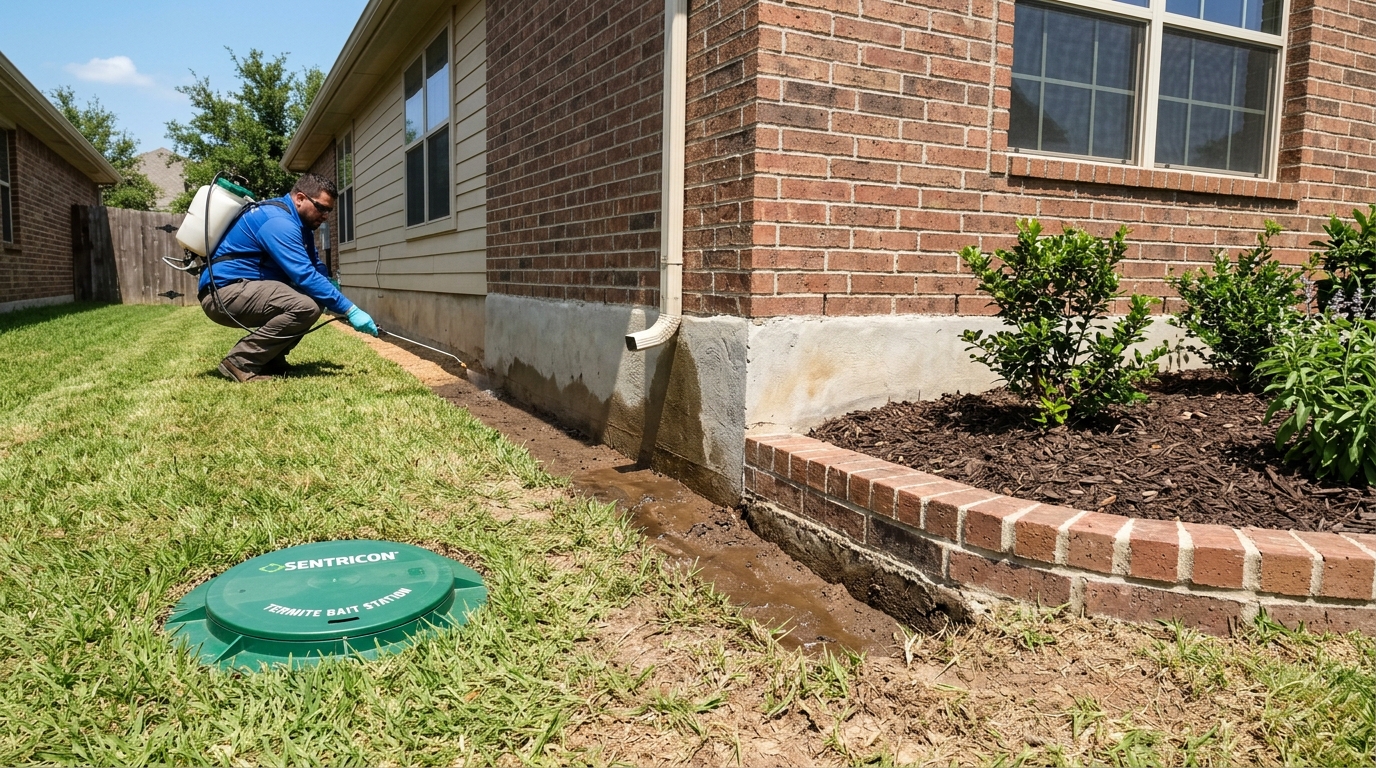
If you have received a termite treatment quote, you may have been offered a choice: a liquid termiticide barrier, a bait station system, or both. Many homeowners do not know enough about either option to evaluate the recommendation — which can leave you wondering if the treatment suggested is genuinely the right fit or simply the one the company makes more margin on.
Here is a straightforward breakdown of how each approach works, when it is the better choice, and what questions to ask.
Liquid Termiticide Barrier: How It Works
A liquid barrier treatment applies termiticide to the soil around your foundation perimeter, creating a treated zone that termites must pass through to reach your structure. Depending on the product, termites that contact the treated soil are either repelled (repellent products) or killed and carry the active ingredient back to the colony (transfer-effect products like Termidor®).
The application process involves:
- Trenching along the exterior foundation edge
- Applying termiticide at the labeled rate per linear foot
- Backfilling the trench
- Drilling through attached concrete slabs (garage, porch) at plumbing penetrations and expansion joints if required
The result is a complete soil barrier around the structure that, under normal conditions, provides protection for 5 to 10 years.
Bait Station System: How It Works
Bait stations are installed in the soil at regular intervals around the property perimeter. Each station contains a wood monitor initially. When termite feeding is detected during a monitoring visit, the monitor is replaced with a bait matrix containing a slow-acting insect growth regulator.
Termites feed on the bait, carry it back to the colony through normal food-sharing behavior, and the colony population declines over weeks to months. Colony elimination typically takes 3 to 12 months depending on colony size. Formosan colonies, being much larger, take longer.
Ongoing monitoring is not optional — stations need periodic inspection to confirm activity and replenish depleted bait. Most monitoring programs run quarterly initially, transitioning to semi-annual once activity is eliminated.
Liquid Barrier: When It Makes More Sense
- Active infestation inside the structure — If termites are currently feeding in your framing, you want the fastest possible colony knockdown. Transfer-effect liquid barriers begin eliminating foragers within days; bait stations work over months.
- Real estate transactions — Buyers and lenders often require evidence of treatment. A liquid barrier provides a documented, immediate treatment that can be verified.
- Slab-on-grade construction — Barrier treatment around a slab perimeter is straightforward and well-suited to this construction type.
- Budget-conscious immediate protection — Initial installation cost for a liquid barrier is generally lower than bait station installation, though bait stations involve ongoing monitoring costs.
Bait Stations: When They Make More Sense
- Landscaped properties — Barrier treatment requires trenching along the full foundation line, which disrupts established plantings, irrigation systems, and hardscape. Bait stations require only small, discrete holes and cause minimal landscape disruption.
- Properties near water — Liquid termiticide application is restricted near drainage features, water wells, and wetlands in Texas. Bait stations have minimal environmental movement and are often the compliant option near water.
- Ongoing colony management — If the goal is continuous interception of new termite pressure rather than a one-time treatment, a monitored bait station system provides year-round active management rather than a barrier that degrades passively.
- Formosan infestations (as supplement) — For Formosan colonies with established carton nests, bait stations combined with liquid barrier treatment provide a more comprehensive knockdown than either alone.
Cost Comparison: What to Expect
Initial liquid barrier treatment is generally less expensive than initial bait station installation for a residential property. However, bait stations involve ongoing monitoring costs (quarterly or semi-annual visits), while a liquid barrier is largely a one-time cost until retreatment is needed (typically 5 to 10 years out).
Over a 10-year period, the total cost of a well-maintained bait station program often exceeds the total cost of a liquid barrier with annual inspections. Neither approach is inherently "cheaper" in the long run — the math depends on your specific property and monitoring frequency.
The Honest Answer
Neither treatment is universally better. What matters is matching the approach to the specific situation: the construction type, the species involved, the extent of activity, the property conditions, and the homeowner's goals. A technician who recommends the same treatment for every property without discussing the options is either following a script or pushing a higher-margin service.
At Huntsville Termite Solutions, we discuss both options after the inspection and recommend what genuinely fits the situation. If both are viable, we explain the trade-offs and let you decide. Call 936-935-0197 to schedule an inspection.
Protect Your Home
Before It's Too Late
Licensed & insured termite specialists serving Walker County.
Same-day inspections. Honest pricing. No contracts.
Mon–Fri 7 AM – 6 PM, Sat 8 AM – 4 PM